

The separation of church and state in the United States is a foundational principle aimed at ensuring freedom of religion and preventing government entanglement with religious institutions. It is rooted in the First Amendment to the Constitution, which states, “Congress shall make no law respecting an establishment of religion, or prohibiting the free exercise thereof.” These two clauses — the Establishment Clause and the Free Exercise Clause — form the basis for keeping government and religion distinct.
 Historical Background
The concept emerged from concerns over the intermingling of church and government in Europe, where state churches often controlled religious life and suppressed dissenting faiths. The Founding Fathers, including Thomas Jefferson and James Madison, sought to prevent similar outcomes in America. Jefferson famously wrote of a “wall of separation between Church and State” in an 1802 letter, expressing the need to keep religious institutions separate from government affairs.
Although the exact phrase “separation of church and state” does not appear in the Constitution, this principle has been a guiding force in American law and governance. It is intended to protect religious freedom for all, ensuring that no single religion is favored by the state.
Legal Interpretation
The U.S. Supreme Court has played a significant role in shaping the understanding of this principle. In Everson v. Board of Education (1947), the Court ruled that the Establishment Clause applies not only to the federal government but also to state governments, thereby reinforcing the separation doctrine. The case involved the use of government funds to provide transportation to students attending religious schools. Although the Court (in a 5-4 decision) held that the facts of this case did not violate the Constitution, all 9 justices reiterated the importance of keeping government neutral regarding religion.
In Lemon v. Kurtzman (1971), the Court established the “Lemon Test” to determine whether a law violates the Establishment Clause. The test has three parts: the law must have a secular purpose, it must neither advance nor inhibit religion, and it must not excessively entangle government with religion. This test has been used to evaluate a variety of cases involving religious displays, school prayer, and public funding of religious organizations.
Modern Challenges
Despite clear legal precedents, debates over the separation of church and state continue. Controversial issues include prayer in public schools, religious symbols in government spaces, and religious exemptions to certain laws. Some argue that the principle should be applied strictly to avoid any government endorsement of religion, while others believe the government should accommodate religious expression as long as no specific faith is favored.
In recent years, debates have extended to areas like healthcare and civil rights (including baking cakes), with religious groups seeking exemptions from laws they believe violate their beliefs. These conflicts highlight the ongoing tension between protecting religious freedom and maintaining the secular nature of government.
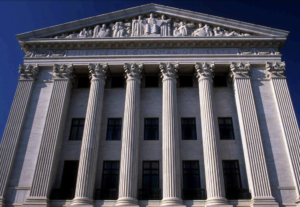
The separation of church and state remains a vital principle in American democracy, designed to protect religious liberty and prevent government interference, though it continues to evolve in the face of legal and societal challenges. (FYI, that’s Moses with the Ten Commandments on top of the U.S. Supreme Court Building.)